

Europe

Acropolis/Parthenon
Alhambra
Amalfi Drive
British Museum
Canals of Venice
Cappadocia
Chambord Chateau
Chartres Cathedral
Colosseum of Rome
Delphi
Dubrovnik
Eiffel Tower
Fjords of Norway
Florence Cityscape
Hagia Sophia
Hermitage Museum
Kremlin
Leaning Tower of Pisa
Louvre Museum
Matterhorn
Mezquita of Cordoba
Mont-St-Michel
Neuschwanstein Castle
Pompeii
Portofino
Prague Old Town
Santorini
Sistine Chapel
St. Basil's Cathedral
St. Mark's Basilica
St. Peter's Basilica
Stonehenge
Topkapi Palace
Uffizi Gallery
Versailles

Asia

Angkor Wat
Baalbek
Bagan Temples/Pagodas
Bali
Banaue Rice Terraces
Borobudur
Forbidden City
Golden Pavilion
Golden Temple
Great Wall of China
Hong Kong Harbour/City
Kashmir Valley
Katmandu Valley
Ladakh
Li River Cruise
Lijiang Shargri-La
Meenakshi
Mt. Everest
Petronas Twin Towers
Potala Palace at Lhasa
Qin Terra Cotta Warriors
Shwedagon Stupa
Taj Mahal
Temple Emerald Buddha
Varanasi/Ganges
Yangtze River Cruise

Africa & Middle East

Abu Simbel
Burj Al Arab
Damascus Old City
Egyptian Museum
Jerusalem Old City
Karnak Temple
Marrakesh
Mecca
Nile River Cruise
Ngorongoro Crater
Petra
Pyramids of Egypt
Sahara Desert
Serengeti Migration
Valley of the Kings
Victoria Falls

North America

Banff National Park
Carlsbad Caverns
Chichen Itza
Grand Canyon
Metropolitan Museum
New York Skyline
Niagara Falls
San Francisco Bay/City
Teotihuacan
Yellowstone
Yosemite

South America

Amazon Rain Forest
Angel Falls
Carnival in Rio
Easter Island
Galapagos Islands
Iguazu Falls
Machu Picchu
Rio Panoramic Views

Other world areas

Antarctica Cruise
Ayers Rock
Bora Bora
Great Barrier Reef

Website

Site map
About my credentials & website
Reader testimonials
Email me your opinion


Amazon Rainforest

candid tips & insights


NEXT Top 100 Wonder
Top 100 RANKINGS
MENU


Why the
Amazon rainforest
is special

The Amazon rainforest is immense (it's larger than Europe). The 6280 kilometer (3900 mile) long Amazon River is fed by a thousand rivers - some over 1600 kilometers (1000 miles) long.


Amazon Rainforest
tips & insights


Geography

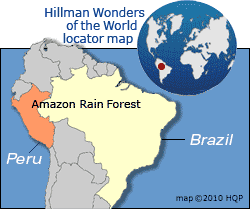
Broadly defined, the Amazon Rainforest extends into nine South American countries. Nearly two-thirds lies in Brazil. Peru is the runner-up.


Getting there

The Amazon's two major gateway airports are in Manaus (Brazil) and Iquitos (Peru).


Getting around

On my first trip to the Amazon, I quickly discovered that road trips are severely limited because the jungle is thick and dissected by numerous snaking rivers. Watercraft and occasionally small airplanes are the most effective means of transportation.


Cruising down
the Amazon

Although it is a popular childhood dream, in reality the view from the deck of a passenger ship soon becomes monotonous. You get a bored dèjá vu feeling as the river and its banks remain virtually unchanged for days on end. And, the dense riverside greenery hides nearly all the wildlife you came to see.


The better
Amazon cruises

They explore the Amazon tributaries and offers interesting land excursions.


Amazon
rainforest lodges

An alternative to cruising is staying in one of the lodges along the small Amazon tributary streams. They range in quality from budget to luxury. Use the lodge as a base to explore nature up close along jungle trails and narrow waterways.


Amazon Rainforest
is vital to life

The Amazon Rainforest produces 20% of the earth's oxygen (and is the source of 20% of our planet's fresh water).


Medicine

A large number of medicines we take for granted come from Amazon plants. And, because so many of the plant species have not yet been analyzed, we should see new drug discoveries.


Amazon Rainforest
survival

About 14% of the world's land was once rainforest. Today it is down to 6%. Greenpeace, an environmental organization, warns that if deforestation continues at the present clip, the Amazon Rainforest will be history in 80 years. Some scientists predict an even earlier demise.


Biologically
rich environment

More than a million colorful plant, animal and insect species inhabit the Amazon Rainforest.


Amazon rainforest
flora & fauna

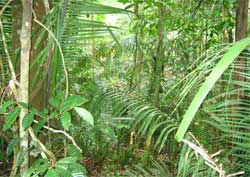
Although the Amazon rainforest looks like other rainforests to the amateur eye, nearly all its plants and animals are unique.


Nutrient recycling

The Amazon ground must be nutrient rich because it fosters profuse plant growth. Right? Wrong. The soil is nutrient poor. The rain forest survives because it quickly recycles its limited nutrient sources.


Water recycling

The Amazon also rapidly recycles its water. When it rains, the trees absorb the water, then let it evaporate, which creates clouds, which generate rain. Half that rain falls on the rain forest. The water shortcoming is made up by westbound clouds from the Atlantic Ocean.


Rainfall

Average annual rainfall approaches 3 meters (10 feet). Some areas can experience twice that amount.


The canopy

High trees create what is called the canopy, a dense umbrella of leaves. Little reaches the ground plants. To survive, they have developed broad leaves to capture as many defused sun rays as possible.


M E N U

NEXT Top 100 Wonder
Top 100 RANKINGS


Other pages & sections
that may interest you

Top 1000 Wonder list
Wonder Guides to 17 countries
Special Topic Guides
Site Map
About Howard Hillman
What Readers Say
Email me your opinion


sponsored ad 

Explore my
candid country, region
and other travel guides

Click links for tips & insights


©2009 HQP / Hillman Quality Publications