

![]()
![]()
![]()
Grand Canyon
Meteor Crater
Monument Valley
Sedona Red Rock Country
Alcatraz Island
Monterey Aquarium
Redwoods National Park
San Diego Zoo
San Francisco
San Francisco Cable Cars
Sequoia National Park
17-Mile-Drive
Yosemite National Park
Kennedy Space Center
Walt Disney World
Hawaii Volcanos National Park
Na Pali Coast
Waimea Canyon
American Museum Natural History
Guggenheim Museum
Metropolitan Museum of Art
Museum of Modern Art
New York Skyline View
Niagara Falls
(with Canada)
Statue of Liberty
Times Square at Night
United Nations
Bryce Canyon
Zion National Park
National Gallery Arts
Smithsonian
Devils Tower
Grand Tetons
Yellowstone National Park
Alaska Cruise
Alaska
Bayous Louisiana
Carlsbad Caverns
New Mexico
Las Vegas Strip at Night
Nevada
Mammoth Caves
Kentucky
Mesa Verde Colorado
Mt Rushmore South
Dakota
America wonder
map
America home page
American cuisine
Site map
About me and my credentials
About my website
Reader testimonials
Email me your opinion


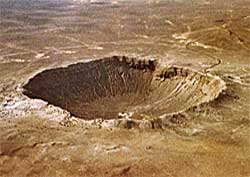
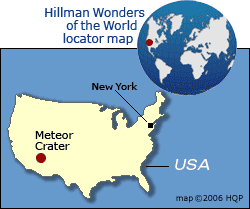
Hundreds of other existing meteorite impact sites exist on earth, but the one in northern Arizona that is simply named "Meteor Crater" is the best preserved. And, its dimensions are astonishing: 1250 meters (4100 feet) wide and 172 meters (570 feet) deep.
The impact of this solar system visitor was 150 times more powerful than the first atomic bomb explosion.
The earth has been struck many more times by meteors than the crater-covered moon, yet has few impact scars because of rain, wind and other forces that erase geologic features.
Yet, despite being 49,000 years old, Meteor Crater is in remarkable fine shape. Main reason: It lies in a very arid environment, which helps thwart erosion.
Meteor Crater is so moonlike that astronauts trained inside for their moon missions.
Meteor Crater is not part of the state or national park system. It is privately owned and operated.
The air-conditioned Learning Center on the north rim has two dozen educational exhibits and an 80-seat theatre showing a 10-minute introductory film.
Outside, there are observation platforms and several high-powered telescopes that permanently point to objects of interest.
The one-hour guided walking tour that skirts the northwest rim gives you a new perspective. In the summer, go on the morning's first tour to avoid the scorching midday heat of this high desert plateau.
In the first half of the 20th century, mining engineer Daniel Barringer dug and drilled deep shafts into the crater floor to find the large remnant of the meteor so he could sell the metal. He failed in his mission, but some people call the geological formation “Barringer Crater” – and the shafts and some of his work buildings and construction gear remain in place today.
Until about a half-century ago, the science community thought that Meteor Crater was volcanic, not meteoritic in origin. Then, astro-scientist Eugene Shoemaker successfully argued that it could only have been created by a powerful meteor impact because of two rare silica minerals found at the location.
In 2005, scientists announced that computer simulations showed that the meteor fragmented and broke into pieces 14 meters (9 miles) before it hit the ground. And, the largest piece (which amounted to about half the original mass) was not traveling fast enough to melt appreciably its iron-nickel composition. That solved the century-old mystery of why large chunks of the fused metal normally associated with meteorites were never found.


sponsored ad

Explore my
candid country, region
and other travel guides
Click links for tips & insights
WONDERS OF ... | WONDERS OF ... | CRUISE GUIDES | WORLD'S TOP WONDERS | OTHER TIPS & INSIGHTS |
|
| |||
SPECIAL TOPICS | MORE | |||
|
| |||
|
| |||
|
|
| ||
|
|
| ||
|
|
| ||
|
|
|
|