


Europe
Acropolis/Parthenon
Alhambra
Amalfi Drive
British Museum
Canals of Venice
Cappadocia
Chambord Chateau
Chartres Cathedral
Colosseum of Rome
Delphi
Dubrovnik
Eiffel Tower
Fjords of Norway
Florence Cityscape
Hagia Sophia
Hermitage Museum
Kremlin
Leaning Tower of Pisa
Louvre Museum
Matterhorn
Mezquita of Cordoba
Mont-St-Michel
Neuschwanstein Castle
Pompeii
Portofino
Prague Old Town
Santorini
Sistine Chapel
St. Basil's Cathedral
St. Mark's Basilica
St. Peter's Basilica
Stonehenge
Topkapi Palace
Uffizi Gallery
Versailles
Asia
Angkor Wat
Baalbek
Bagan Temples/Pagodas
Bali
Banaue Rice Terraces
Borobudur
Forbidden City
Golden Pavilion
Golden Temple
Great Wall of China
Hong Kong Harbour/City
Kashmir Valley
Katmandu Valley
Ladakh
Li River Cruise
Lijiang Shargri-La
Meenakshi
Mt. Everest
Petronas Twin Towers
Potala Palace at Lhasa
Qin Terra Cotta Warriors
Shwedagon Stupa
Taj Mahal
Temple Emerald Buddha
Varanasi/Ganges
Yangtze River Cruise
Africa & Middle East
Abu Simbel
Burj Al Arab
Damascus Old City
Egyptian Museum
Jerusalem Old City
Karnak Temple
Marrakesh
Mecca
Nile River Cruise
Ngorongoro Crater
Petra
Pyramids of Egypt
Sahara Desert
Serengeti Migration
Valley of the Kings
Victoria Falls
North America
Banff National Park
Carlsbad Caverns
Chichen Itza
Grand Canyon
Metropolitan Museum
New York Skyline
Niagara Falls
San Francisco Bay/City
Teotihuacan
Yellowstone
Yosemite
South America
Amazon Rain Forest
Angel Falls
Carnival in Rio
Easter Island
Galapagos Islands
Iguazu Falls
Machu Picchu
Rio Panoramic Views
Other world areas
Antarctica Cruise
Ayers Rock
Bora Bora
Great Barrier Reef
Website
Site map
About my credentials & website
Reader testimonials
Email me your opinion


NEXT Top 100 Wonder
Top 100
Wonder rankings
NEXT USA
Wonder
MENU
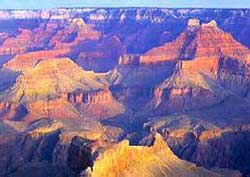
"Grand" is an understatement. At its extremes, the Grand Canyon is 446 kilometers (277 miles) long, up to 29 kilometers (18 miles) wide from rim to rim. and over 1600 meters (a mile) deep.
Vastness is just one of the mind boggling elements of the Grand Canyon that renders me nearly speechless. The setting is desolate, the contours are rugged, and the striated hues of the gorges and pinnacles are vibrant.
It took the erosive effects of the Colorado River millions of years to carve a deep swath through billion-plus year-old rock layers.
The process began in two stages, one roughly 17 millions years ago, the second, about 6 million years ago.
The view is best from the South rim - it has the most breathtaking vantage points. And, unlike the case on the north rim, the sun is over your shoulder, which is best for both sightseeing and for taking photos.
For the most awesome and thrilling perspective, fly below its rims in a sightseeing helicopter (best bet) or small plane.
To appreciate the size of the nearly 500-kilometer (300-mile) long Grand Canyon, view it at 35,000 feet aboard a commercial jet. Note: The flight paths of many transcontinental planes to and from major Southern Californian cities skirt this natural wonder.
For an exciting trip, take the mule ride to the Grand Canyon floor. The trip is not recommended if you have a fear of heights because some sections of the trail are narrow and have steep drop offs without rails.
You can also hike to the bottom, but the roundtrip requires too much physical exertion and too many hours for other than a highly fit trekker. It's best to descend one day, camp overnight (permit required), then take the tiresome hike up the next day.
Another option is to travel through the Grand Canyon in an inflatable boat. Running the Colorado River rapids is a harrowing experience, which is part of the fun. Most trips last 5 to 8 days, some longer. One outfit offers a shorter itinerary - you helicopter in, do some rafting, then helicopter out.
Many visitors assume that the canyon floor is cooler than on the rim. It's not. July temperatures reach 41°C (106°F) and higher.
You'll be in the wild. Though rare, it's possible to cross the paths of rattlesnakes and mountain lions.
June to mid September is the peak tourist season.
Make your summer reservations early for the in-the-park lodges and camps because they become completely booked months in advance. The same can be true for the accommodations outside the park for weekends and holidays. Sadly, many tourists arrive expecting miracles.
Enter the park early if you are a day tripper. Otherwise, you may have trouble finding a parking space.
It can be nerve-racking. Leave your car parked and take the free shuttle bus to the major lodges and lookout points so you won't have to repeatedly search for scarce parking spaces.
Bring an umbrella. Heavy rains occur mostly in the summer, particularly in August.
If you are thinking about coming in the winter to avoid the crowds, remember it is cold and can be snowy with icy roads. Moreover, daylight is short and winter storms can obscure the view.
The best all around periods are May and mid-September to mid-October. Crowds are relatively thin and the weather is pleasant (though, remember, the Grand Canyon weather can be unpredictable).
Over four million tourists visit the Grand Canyon per year. About 9 out of 10 of them choose the South Rim.
The distance between the North Rim and South Rim main facilities is about 25 kilometers (15 miles) as the bird flies. By car, it's over 300 kilometers (200 miles).
The park has a rim trail for those who want a less populated view of the Grand Canyon.
The best time to see or photograph the Grand Canyon is in the early morning or late afternoon on sunny days. The low angled sun rays intensify the hues of the rock layers.

NEXT Top 100 Wonder
Top 100 Wonder rankings
NEXT USA Wonder
USA Wonder Guide
Clickable USA Wonder Map
American Cuisine
Guide

Top 1000 Wonder list
Wonder Guides to 17 countries
Special Topic Guides
Site Map
About Howard Hillman
What Readers Say
Email me your opinion

sponsored ad

Explore my
candid country, region
and other travel guides
Click links for tips & insights
NATION / REGION |
| CRUISE GUIDES | SPECIAL TOPICS | OTHER TIPS & INSIGHTS |
| ||||
| MORE | ||||
| ||||
| ||||
| ||||
|
| |||
|
|
| ||
|
|
|