

Great Wall of China

travel wonder

Why the Great Wall

of China is special

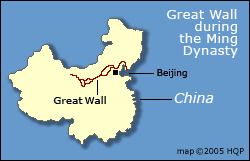
It is by far mankind's most extensive construction endeavor. In its heyday in the 16th and 17th centuries, it snaked 6400 kilometers or 4000 miles across northern China (see map).
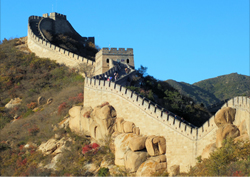
It zig-zags up and down steep ridges and is punctuated with imposing watchtowers, making the Great Wall of China one of the most photogenic man-made structures on earth.

Today, it is the travel icon of China - and one of the leading vacation travel destinations in the world.

Why the Great Wall 

of China was built

Among the many reasons:

To serve as lookout posts - The ancient Chinese had rational fears about being invaded by nomadic armies from the north.

To provide the army with a swift early warning system - Fire signals (nighttime) and smoke signals (daytime) were relayed from one watchtower to another. Messages could be rapidly sent over great distances.

To create an elevated military roadway through the rugged terrain - This helped speed the deployment of soldiers from one area to another along the Great Wall of China.

To impede invaders - This worked against feeble armies. However, the wall would serve more as a psychological than a physical barrier against a determined, well-manned military force. A formidable invader could easily breach a lightly guarded part of the wall. Or, it could muscle its way through one of the gaps between the individual wall sections.

Great Wall of China –

how it came to be

No one ever said, "Let's build the Great Wall of China". There was never a master plan. Initially, powerful regional kingdoms built sections solely for their own defensive military needs.

The earliest known sections were constructed in the 7th century BC.

Building activity by the regional kingdoms flourished in the 5th and 3rd centuries BC.

It was only after the Qin Dynasty (221-206 BC) unified China did the wall become a collective entity. The Qin dynasty repaired, renovated and linked old sections and built new ones. Note: The modern word "China" derives from the Qin (pronounced "Chin") Dynasty.

Over the next 1700 years, the Great Wall of China was enlarged and enhanced. Most of what tourists see today is the fruit of the work done in the 16th and 17th centuries.

The Great Wall 

of China today

Although much of it is in disrepair or deteriorated, some wall sections are in fairly good condition, thanks to repairs, renovations and protection programs by the Chinese government.

There are currently slightly over 100 known sections ranging in states from deteriorated ruins to skilled restorations. One section was discovered just a few years ago. Archaeologists believe that some sections still lie buried and are waiting to be discovered.

Debunking a 

Great Wall myth

It is popularly written that the wall is so long that you could see it with the unaided eye from an orbiting spacecraft (and some say from the moon) That would be impossible.

Despite the Great Wall's extraordinary length, it's too narrow to be seen from an orbiting spacecraft without a telescope or super binoculars. Spotting the Great Wall from that height is analogous to being able to see a stretched-out mile-long thread on the ground while standing on top of a ten-story building.

Great Wall of

China insights

Over the centuries more than a million people (peasants, soldiers and prisoners) helped build the wall. Thousands died in the process.

In ancient times the Great Wall of China was called the Ten Thousand Li Wall. This name referred to the wall's length (a li is a unit of measurement equaling roughly a half kilometer or one-third mile).

While the sections in eastern China were mainly made with bricks and chiseled stones, those in western China were made with less durable materials (often with clay or pounded earth reinforced with tree branches).

The path stretches from a seaport on China's east coast to Xinjiang in China's north west. In between, it passes through a variety of terrains, including mountains, plateaus and deserts.

The width and height of some sections are impressive. The average dimensions are roughly 6 meters (18 feet) wide and 8 meters (25 feet) high. The watchtowers normally add about 4 meters (13 feet) to the height.

The Great Wall of China watchtowers are fairly close to each other along many stretches of the Great Wall. Some are a stone's throw apart.

Most watchtowers were not garrisoned at any given time. Troops were regularly redeployed between one and another watchtower. The military goal was to keep the invading enemy guessing how many defending soldiers might be occupying a given watchtower.

Weathering through the centuries caused the lion's share of the damage to the wall. Other culprits were local residents seeking free building materials, souvenir-hungry travelers, and uncaring hikers.

The 4 most popular

Great Wall of China sites

Below are the four most visited Great Wall locations. All are near and north of Beijing:

Badaling - This is by far the most popular Great Wall of China site for travelers, mainly because it is close to Beijing (less than two hours away) and is much easier to climb than the other Great Wall sections. The Badaling section was built around 500 years ago - and was extensively renovated by the present Chinese government over the last several decades. Be mindful that Badaling swarms with tour groups, individual tourists and hawkers - and has become somewhat tacky. This could taint your photographs and memories of an otherwise visually striking Great Wall of China site.

Mutianya - It is an hour further away from Beijing than Badaling. This is a blessing - the extra travel time means that fewer vacation tour groups will travel to it. This Great Wall of China site is remarkable. The incline of the wall at Mutianya is noticeably steeper than Badaling's. However, like Badaling, Mutianya has a cable car for tourists who choose not to walk up the wall.

Simatai - You must travel yet another hour to reach the Simatai site from Beijing and, therefore, you will encounter even fewer vacationers than at Mutianya. Some of the wall dramatically clings to precipitous mountain ridges. Because the incline is especially steep and there is no cable car, I do not recommend the Great Wall of China site at Simatai for those not in good physical condition.

Shixiaguan - This is the closest section to Beijing. The Shixiaguan section is currently being reconstructed but is open to the public. You can view it from your vehicle as you drive to the Badaling section (see above). Or, you can stop and climb it. However, be aware that the Shixiaguan wall ascends a long, very steep slope. 

Best times for visiting

the Great Wall of China

The best hours

Go in the early morning or late afternoon when sightseeing buses are relatively scarce. And, the low-angled sun rays help make great photographs. Crowds can be thick from mid-morning to mid-afternoon.

The two best months


May - Usually sunny (though you could encounter occasional rains). Wild flowers are abloom. Vacation travel season has begun, but modestly so.

October - Usually sunny (and even less chance of rain than in May). Moderate tourist count. Fall temperatures are brisk, but refreshing and comfortable, making it a pleasant time to travel to the Great Wall of China.  

The next best months

June to September - Although summer is the rainy, humid season and the vacation tour season is in full swing, it's better to visit the Great Wall of China then than during the winter (see next item) or not at all.

The least desirable months

November to April - You'll share the Great Wall of China with few tourists. And, it's the dry season. However, the weather can be bitterly cold and biting, especially in January and February.

View my other gold,

silver & bronze medal

winners in China

My Chinese

phrase guide

for travelers

What every visitor should know.

View my Chinese

cuisine guide

View my next

top 100 world wonder

I hope your China travel dreams come true - and that 

my Great Wall page helps you enjoy your vacation, tour or trip

©2008 HQP / Hillman Quality Publications