


Pantheon
Travel tips you can trust

Why the
Pantheon in Rome
is special
It and its astonishing dome have stood for nearly 1900 years. The Pantheon is by far the best-preserved ancient Roman building.
Pantheon
tips and insights
 The Pantheon's
design star
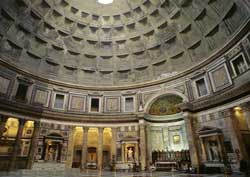
Though its exterior has its merits, the interior can knock visitors off their feet (see photo). The colored marble walls and sculpting provide luxuriant decoration. And, if the word "grand" didn't exist, the dome would coin it.
The remarkable
Pantheon dome
 The
dome measures 42 meters (142 feet) in diameter - an amazing feat for 125 A.D.
The
dome measures 42 meters (142 feet) in diameter - an amazing feat for 125 A.D.
It
remained the world's largest dome for over 1400 years.
The
Roman architects reduced its weight by using a revolutionary blend of
concrete made with lightweight volcanic rocks. The exact
recipe has been lost in time.
The
dome has a large open-air hole at its top (see photo). It allows natural light to
eye-pleasingly bathe the interior. Yes, rain occasionally enters.
Pantheon's
construction history
The Pantheon was originally built in 25 BC, but was destroyed by fire in 80 AD. Roman Emperor Hadrian rebuilt it in 125 AD. He changed its defining shape from rectangular to circular. That design is essentially what we see today. Though some major details have been modified over the centuries.
Relgious
function
In 609 A.D., the Pantheon was consecrated as a church, as it remains today. The illustrious Renaissance painter Raphael is interned here, along with two Italian kings.
What the
name means
Pantheon means "Temple of the Gods", referring to Roman deities. The name derives from the Greek words pan (all) and theo (god).
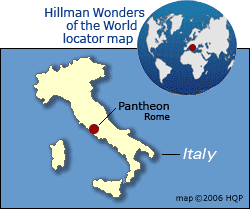
Location in Italy
Read my other Italy pages
Wonders of Italy - Complete list
Italy wonder map
Basic Italian phrases
Italian cuisine
Best time to visit Rome


World's Top 100 Wonders
World's Top 1000 Wonders
Site map
My credentials
About my website and criteria
Reader testimonials