

Mount Everest

travel wonder in China & Nepal

Why
Mount Everest
is special

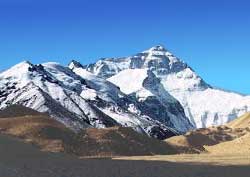
Mount Everest is the world's tallest mountain.

Mount Everest

tips & insights

Not recognized until 19th century

No one realized that it was the tallest until 1856.

Official height

The official height of Mount Everest is 8848 meters or 29,029 feet, which is based on a 1954 ground-based measurement. However, in 1999, a National Geographic Society satellite-based measurement indicated that Mount Everest was about 2 meters (6 feet) taller.

Still growing

Mount Everest is not standing still. Due to massive geological forces, it is rising at the rate of almost 1 centimeter (1/3 inch) per year - and moving northeast at about 6 centimeters (2 inches) per year.

Shared by two countries

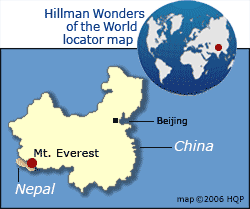
The Mount Everest summit straddles the border between Nepal and Tibet, China.

First ascent

In 1953, Edmund Hillary and Tenzing Norgay became the first humans to scale Mount Everest. Some say two climbers accomplished this feat in 1924, but the evidence is weak.

Since 1953

More than 2,200 people have reached the summit, but over 200 climbers died.

Dangers

Climbers face many deadly dangers, including:

Avalanches

Slippery ice

Collapsing crevasses

Sudden storms

Strong winds

Subzero temperatures

Oxygen deprivation

Then why do people want to climb Mount Everest? Certainly, challenge and prestige are two answers. Another is "Because it is there", as mountaineer George Mallory stated.

Among the successful

A blind person, a one-legged person, a 15 year old, and a 70 year old have successfully made it to the top. And other adventurers have skied, snowboarded and hang glided down the mountain.

Cost

Climbing Mount Everest is not cheap. Commercial expeditions can cost climbers $60,000 to $75,00 each.

Surest route

The southern ridge is the most popular (and easiest) route to the summit.

Window of opportunity

The annual window for ascending Mount Everest is short. Normally, conditions in this part of the Himalayan Mountains are the most favorable in April and May. Before then, the freezing winds are too strong. After May, the stormy monsoon season arrives.

Overcrowding

In the last decade, Mount Everest has been attracting too many climbers for its own good, say environmentalists. During the April to May window, base camps are unbearably crowded with hopefuls.

Littering

Sadly, mountaineer litter bugs discard plastic packaging and non-biodegradable climbing gear (including empty oxygen tanks) on the formerly pristine slopes.

Non-climbing hikers

Mount Everest is seen up close annually by tens of thousands of hardy hikers who trek to breathtaking vantage points.

Non-hikers

They can see Mount Everest, too (though from greater distances). China and Nepal have sites for them. Darjeeling in India also has a special viewing spot.

Flight-seeing

Alternatively, you can take a flight-seeing tour. Some fly within a couple of miles of Mount Everest.

Native names

Don't call the mountain "Mount Everest" in Tibet or Nepal. That's British coinage. Tibetans refer to it as Chomolungma and Nepalese call it Sagarmatha.

View my other gold,

silver & bronze medal

winners in China

My Chinese

phrase guide

for travelers

What every visitor should know.

View my Chinese

cuisine guide

View my next

top 100 world wonder

I hope your China and Nepal travel dreams come true - and that 

my Mount Everest page helps you enjoy your vacation, tour or trip

©2008 HQP / Hillman Quality Publications