

Panama Canal
Travel tips you can trust
Why the
Panama Canal
is special
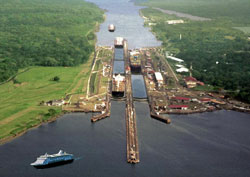
The construction in the early 20th century was an astounding engineering feat and the waterway is today a vital artery for world trade. It nautically links the Atlantic with the Pacific Ocean by cutting across the Isthmus of Panama.
Panama Canal
tips and insights
 Panama Canal
history in brief
 Early 16th century
Explorer Balboa crossed the isthmus and saw the Pacific. It did not take long for his King Charles I back in Spain to dream about creating the canal.
1889
A French company made a serious seven year attempt to build the canal, but failed. Over 20,000 people died, mainly caused by malaria and yellow fever, not construction accidents.
1914
An American effort succeeded. However, as before, malaria and yellow fever caused significant casualties.
Today
The Panama Canal is run by the Panamanian government.
It was more difficult
to build the Panama Canal
than its Suez cousin.
Although the Suez Canal is considerably longer, it traversed a relatively flat dessert landscape. In contrast, the Central America isthmus waterway had to go up and then down a small mountain. In addition, the workers lived in a then highly risky tropical disease environment.
Transit time & cost
Transit normally takes about nine hours and averages US $30,000 per ship, but the toll can exceed US $100,000 for very large ships.
If the passage never existed
Ships sailing between New York and San Francisco (or the Orient) would face an added burden. They would have to travel around the tip of South America, where perilous stormy seas are not uncommon. Moreover, the southern hemisphere route adds about 13,000 kilometers (8,000 miles) and many extra days of travel to the trip.
Locks
Part of the 80 kilometer or 51-mile long Panama Canal is occupied by three sets of gigantic locks. They are built in parallel pairs to allow two way traffic. However, sometimes ships on both sides travel in the same direction.
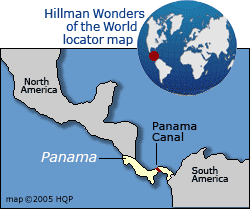
Location

World's Top 100 Wonders
World's Top 1000 Wonders
Site map
My credentials
About my website and criteria
Reader testimonials