


Galapagos top 5
land & shore wildlife
rankings
Cruise tips you can trust
Galapagos land/shore -
wildlife rankings
Criteria: Interest among sophisticated visitors to the Galapagos.
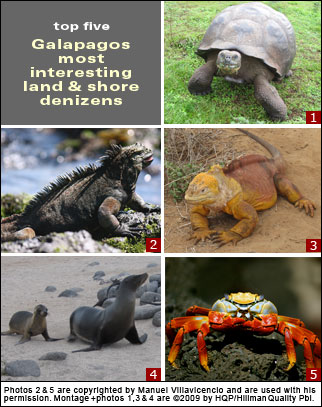
 Giant tortoises

 Once, 250,000
existed in the Galapagos. Today, the population is down to 15,000, mainly
due to 19th-century whalers harvesting them for food and
liquid.
Once, 250,000
existed in the Galapagos. Today, the population is down to 15,000, mainly
due to 19th-century whalers harvesting them for food and
liquid.
The most
famous giant tortoise was the century-and-a-half old Lonesome George,
who livef comfortably at the Charles Darwin Research Center on
Santa Cruz Island.
The
carapace (upper part of the shell) is unique on each Galapagos island,
an evolutionary development.
The giant
tortoise is the largest land or sea turtle in the world.
It weighs up
to 250 kilograms (550 pounds).
The
giant tortoises' estimated lifespan is 150 years, some experts believe longer.

Espanola, Isabela,
Santa Cruz, San Cristobal, and Santiago.
 Marine iguanas
This Galapagos
species is famous for its prehistoric monster-like appearance (see photo).
Some reach one meter (three feet) in
length.
Marine iguanas
are the world's only bona fide sea-going lizard.
These
Galapagos creatures spend their leisure time onshore lazing together on dry,
lava rock for warmth and protection (their soot-black skin camouflages
them).
Marine
Iguanas are mainly vegetarians. They dive-feed in the sea, mainly for young
algae and seaweed.
Fernandina, Floreana, Isabela, North Seymour, and Santa Cruz.
 Land iguanas
These
sizable "dragon" lizards measure up to 3 meters long and some
live over 60 years.
The
land iguana's normally yellow-orange to brown-color skin
makes it a snap for first-timers to distinguish them from
marine iguanas, their distant relative.
Land
iguanas prefer dry island areas.
Diet is mainly vegetarian.
Cactus
fruit is a favorite food, for substance, nutrients and water.
Espanola, Fernandina, Isabela, and
Santa Fe.
Click for more
land & shore
wildlife tips
PAGE TWO - wildlife rankings # 




Best Galapagos ships by category
Boat type - pros & cons
Itinerary tips
Cost and booking tips

Best time to go
Getting there tips
Packing tips
Snorkeling tips
Diving tips
Some more helpful tips

Top 5 land & shore wildlife
Top 5 birds
Top 5 marine life

Charles Darwin - Brief bio
Interesting Galapagos facts
Celebrity Xpedition

World's Top 100 Wonders
World's Top 1000 Wonders
Site map
My credentials
About my website and criteria
Reader testimonials