


Angora &
Hephaestus Temple
Travel tips you can trust

Why the
Ancient Agora
and Hephaestus Temple
in Athens are special
"Agora" in Greek means "a gathering place". And so it was in Athens and some other cities of Greece. It was the civic center of political, social, intellectual, judicial and commercial life.
The Agora site is visually enhanced by the presence of its neighbor, the Hephaestus Temple.
Agora
tips and insights
 Socrates
He often sauntered through the Ancient Agora as he lectured Plato and his other students. His life later ended here when he downed the fatal hemlock drink.
Deterioration
He often sauntered through the Ancient Agora as he lectured Plato and his other students. His life later ended here when he downed the fatal hemlock drink.
Excavation
The site lay hidden until it was unearthed in the 1890s during a railroad construction project. When Athenians recognized its historic value, non-Agora structures were torn down and the Ancient Agora was slowly excavated.
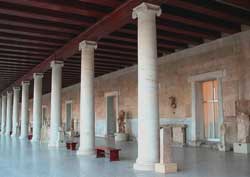
Almost all the buildings we see today are flattened ruins, comprised mostly of foundation blocks and floor slabs. One notable exception is the colonnaded Stoa of Attalos (see photo). It was restored in the 1950s. Unfortunately, it was rebuilt in a style that vaguely reminds me of a Las Vegas hotel lobby.
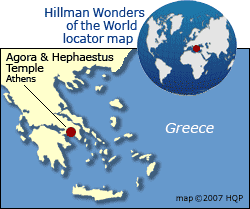
Location in Greece
Learn More
 for Agora/Hephaestus - Page 2
Know my other
Greece tips and insights
Greece wonders - Top 10 rankings
Greece wonder map
Basic Greek phrases for travelers
Greek cuisine


World's Top 100 Wonders
World's Top 1000 Wonders
Site map
My credentials
About my website and criteria
Reader testimonials