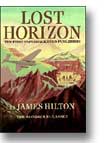


Lost Horizon

the famous book and movie

About the
Lost Horizon book
and the debate
it created

The heated discussion

British author James Hilton coined the name "Shangri-La" in his 1933 best-selling novel "Lost Horizon". He used it to describe a fictional utopian lamasery that was secluded in a high valley in or near the Himalayan Mountains.

Ever since, people have ardently debated where Shangri-La might be.

The story in brief

In the early 1930s, a plane carrying four Westerners crash lands in the remote snowy mountains of Central Asia. Some Shangri-La denizens find and take them to their secret valley. The Westerners are told philosophical concepts such as "Do everything in moderation". Tension builds among the foreigners on whether they should stay in this utopia or go back to what they know as civilization. Eventually, the hero Hugh "Glory" Conway leaves.

The first book of its kind

The novel Lost Horizon was initially a hardcover edition. Years later, it became the world's first paperback book.

Lost Horizon the movie

Hollywood transformed the book into an immensely popular motion picture in 1937 (see poster below). Like most films based on books, this one took liberties with the author's characterizations and story line.

Note: There was a remake of the Lost Horizon movie 36 years later, in 1973. Whereas the critics praised the original (1937) film, they panned the 1973 version.

How the name evolved

Some linguists believe James Hilton adapted the term "Shangri-La" from a Tibetan word with a similar pronunciation.

What the name signifies

The Lost Horizon book and film created in the minds of millions around the globe an image of a tranquil place where people live in peace, harmony and goodwill - and enjoy long life spans.

Shangri-La tourism

This fame and image motivated some areas in Central Asia to begin marketing themselves as "the" Shangri-La to lure tourists. 

Where is Shangri-La?

Determining with certainty its precise geographical location is futile. Not only is Shangri-La fictional, the author James Hilton was vague about its specific locality.

However, he did narrow it down to "Tibet". That eliminates Nepal and Bhutan, but not Yunnan and Sichuan.

I base this on my historical research on Kham. When James Hilton penned Lost Horizon, much of the area where Yunnan and Sichuan converge with modern-day Tibet was part of the land then known as Kham. And, Kham was one of the three major sectors that defined Tibet at that time.

Moreover, James Hilton never set foot in Central Asia. His inspiration for writing his tale? Chances are it was a popular series of articles published in the early 1930s in the National Geographic magazine. They were written by botanist Joseph Rock, who explored the convergent area, which was unknown to most of the world.

China's Shangri-La

In 2002 the Chinese government specified that China's Shangri-La was in the area where Yunnan, Sichuan and Tibet meet.

China's advantage

I believe all the non-Chinese areas claiming to be Shangri-La are stunningly beautiful like the Chinese area. Therefore, they also deserve a Shangri-La label. However, from a tourist's perspective, China has an important advantage: Its Shangri-La is more accessible in terms of transportation and local tourism infrastructure.

Lijiang & Shangri-La menu

My Chinese

phrase guide

for travelers

What every visitor should know.

I hope your China travel dreams come true - and that 

my Lost Horizon page helps you enjoy your vacation, tour or trip

©2008 HQP / Hillman Quality Publications