

Europe

Acropolis/Parthenon
Alhambra
Amalfi Drive
British Museum
Canals of Venice
Cappadocia
Chambord Chateau
Chartres Cathedral
Colosseum of Rome
Delphi
Dubrovnik
Eiffel Tower
Fjords of Norway
Florence Cityscape
Hagia Sophia
Hermitage Museum
Kremlin
Leaning Tower of Pisa
Louvre Museum
Matterhorn
Mezquita of Cordoba
Mont-St-Michel
Neuschwanstein Castle
Pompeii
Portofino
Prague Old Town
Santorini
Sistine Chapel
St. Basil's Cathedral
St. Mark's Basilica
St. Peter's Basilica
Stonehenge
Topkapi Palace
Uffizi Gallery
Versailles

Asia

Angkor Wat
Baalbek
Bagan Temples/Pagodas
Bali
Banaue Rice Terraces
Borobudur
Forbidden City
Golden Pavilion
Golden Temple
Great Wall of China
Hong Kong Harbour/City
Kashmir Valley
Katmandu Valley
Ladakh
Li River Cruise
Lijiang Shargri-La
Meenakshi
Mt. Everest
Petronas Twin Towers
Potala Palace at Lhasa
Qin Terra Cotta Warriors
Shwedagon Stupa
Taj Mahal
Temple Emerald Buddha
Varanasi/Ganges
Yangtze River Cruise

Africa & Middle East

Abu Simbel
Burj Al Arab
Damascus Old City
Egyptian Museum
Jerusalem Old City
Karnak Temple
Marrakesh
Mecca
Nile River Cruise
Ngorongoro Crater
Petra
Pyramids of Egypt
Sahara Desert
Serengeti Migration
Valley of the Kings
Victoria Falls

North America

Banff National Park
Carlsbad Caverns
Chichen Itza
Grand Canyon
Metropolitan Museum
New York Skyline
Niagara Falls
San Francisco Bay/City
Teotihuacan
Yellowstone
Yosemite

South America

Amazon Rain Forest
Angel Falls
Carnival in Rio
Easter Island
Galapagos Islands
Iguazu Falls
Machu Picchu
Rio Panoramic Views

Other world areas

Antarctica Cruise
Ayers Rock
Bora Bora
Great Barrier Reef

Website

Site map
About my credentials & website
Reader testimonials
Email me your opinion


Stonehenge

Candid tips & insights


NEXT Top 100 Wonder
Top 100 Wonder rankings
NEXT England Wonder
MENU


Why
Stonehenge
is special

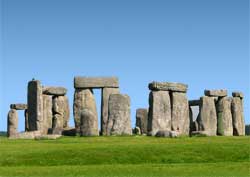
Stonehenge in England is a prehistoric site of megaliths arranged in concentric circles and horseshoe patterns.


Stonehenge

tips & insights


Size

These standing Stonehenge megaliths are up to 6 meters (21 feet) high and 45,000 kilograms (100,000 pounds) heavy.


Provenance

Some of the large stones were brought  from a mountain quarry 30 kilometers (18 miles) away using crude ancient means.


Unanswered questions

Stonehenge is shrouded in mystery, which is part of its appeal to tourists and sleuthing archaeologists.

Many questions remain open to debate, including these three:

When was Stonehenge built?
Latest scientific estimates say it was erected in stages between 3000 BC and 1500 BC.
Why was Stonehenge built?
The best speculation is it was an astronomical calendar (a headstone is oriented toward the summer solstice). Another sound theory is Stonehenge was used for religious ceremonies.
Who built Stonehenge?
No one will probably ever know for certain. The once popular theory that the Druids (Celtic priesthood) erected it was shot down when modern science proved that Stonehenge was constructed at least a thousand years before their time.

Today

Just 17 of the site's estimated 80 original megaliths stand.


M E N U

NEXT Top 100 Wonder
Top 100 Wonder rankings
NEXT England Wonder


More England
features

England Wonder Guide
Clickable England Wonder Map
English Cuisine Guide


Other pages & sections
that may interest you

Top 1000 Wonder list
Wonder Guides to 17 countries
Special Topic Guides
Site Map
About Howard Hillman
What Readers Say
Email me your opinion


sponsored ad 


Explore my
candid country, region
and other travel guides

Click links for tips & insights


©2009 HQP / Hillman Quality Publications