


Newgrange
Travel tips you can trust

Why
Newgrange
is special
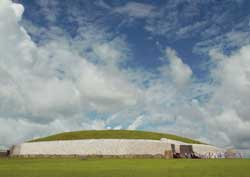
Newgrange in Ireland is a major Neolithic site built around 3200 BC and was designed to document the winter solstice. This large, grass-covered circular mound predates the Great Pyramids of Egypt by a half millennium.
Newgrange
tips and insights
 Entrance requirement
The site attracts 200,000 visitors per year. Access is by group tour only. After you buy your ticket at the nearby visitors center, your assigned group is bussed to the site.
Winter solstice
Once a year, on December 21st (shortest day of the year), the inner passage is lined up perfectly with the rising sun.
 At dawn, for 17 minutes
A sunbeam passes through the inner passage and illuminates the central chamber's floor.
Visitor lottery
About 100 people (out of nearly 30,000 applicants) are selected each year by lottery to witness the solar-alignment event.
Throughout the year
The solar event is reenacted by artificial light for all group tours.
Stonehenge comparison
Although most archaeologists believe that Stonehenge in England is a more significant Neolithic site than Newgrange, some disagree.
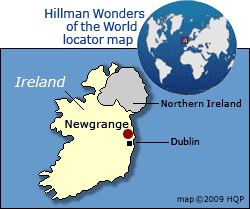
Location in Ireland
Learn More
 for next Newgrange page
Know these tips and insights
Ireland wonders - Top 5 rankings
Ireland wonder map
Top 3 most famous Irish songs - Lyrics
Irish cuisine



World's Top 100 Wonders
World's Top 1000 Wonders
Site map
My credentials
About my website and criteria
Reader testimonials