

Pyramids of Egypt

travel wonder at Giza

Why the

Pyramids of Egypt

are special

The Pyramids of Egypt are so massive they confound the imagination. They are even more amazing when we consider that they were built nearly 4600 years ago.

About my animated

picture of the

Pyramids of Egypt

The animated picture on the right illustrates the marked difference in appearance between the way the Pyramids of Egypt look originally and today.

When built, they were covered with a smooth limestone surfacing that gave them a sleek finished look. 

Today they have a rugged exterior because subsequent ancient rulers filched the surface stones from the monuments for use on their own buildings. 

Khufu's Pyramid

reigns supreme among

the three great

Pyramids of Eqypt

Pharaoh Khufu's structure is the oldest, biggest and most famous of the great Pyramids of Egypt.

It was built during the reign of pharaoh Khufu (2589 to 2566 BC) and is the only true surviving member of the Seven Ancient Wonders of the World.

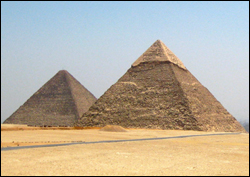
Khufu's edifice is the farthest of the three great Pyramids of Egypt in the above picture. It seems shorter than the middle pyramid (Chephren's) for two reasons. First, Khufu's sits higher on the plateau than Chephren's. Second, the photographic vantage point makes Khufu's seem smaller.

For more insights on the pyramid of Khufu, click the round green "7 Wonders" button. Because Khufu's pyramid is one of the original Seven Wonders of the World, it has its own dedicated web page in the Seven Wonders section of this website.

The mummies are

missing from all

three of the great

Pyramids of Egypt

The mummies were likely removed long ago by sophisticated tomb robbers. The priceless buried treasures of the pharaohs were also taken.


Interesting tidbits

about the Pyramids

of Egypt at Giza

Many theories exist on how the Pyramids of Egypt were constructed. Most Egyptologists now believe that a large temporary earth ramp with a gentle incline was built. The giant stone blocks were then dragged up the slope with a combination of pulleys, levers and raw manpower. 

Over the course of several centuries, the construction design evolved from the modestly high step pyramid style to the skyscraping, smooth-sided pyramids of Khufu and Chephren at Giza. 

Then, starting with Menkure's pyramid (the nearest one in the picture), size and structural strength gradually began to decline. The primary reasons were weakening economies and fading pharaonic powers. 

The three great Pyramids of Egypt have a north-south alignment because the polar stars were considered sacred. 

The number of large stone blocks used to build the Pyramids of Egypt is often overstated. For example, it is commonly written that 2,300,000 million were used for Khufu's structure. The actual figure is many times smaller when you divide the cubic size of the pyramid by the average cubic size of the stone blocks. 

Some archaeologists speculate that the tomb robbers were unsuccessful in finding the true burial chambers in the Pyramids of Egypt because the tomb builders were cleverer than the thieves. If so, the pharaonic mummies and treasures are still concealed somewhere within their respective pyramids, waiting to be detected by future technology.

View my other top 100

Wonders of the World

I hope your Egypt travel dreams come true - and that 

my Pyramids of Egypt page helps you enjoy your vacation, tour or trip

©2008 HQP / Hillman Quality Publications