

Colossus of Rhodes

Seven Wonder


Why the
Colossus of Rhodes
Seven Wonder
is special

The Colossus of Rhodes in Greece was as tall as a modern 15-story building. This was an amazing architectural feat when this statue-and-pedestal structure was built on the island of Rhodes around 280 BC.


Colossus of Rhodes
tips & insights


No one today knows for
sure what the Colossus
of Rhodes looked like or
where it was situated.

Yet, I heard a half dozen different answers from local experts while I was in Rhodes.


Questionable concept

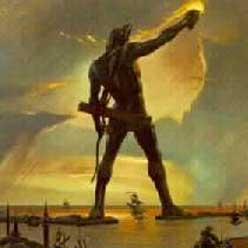
The popular notion is that the Colossus of Rhodes straddled the harbor's entrance and ships sailed between its legs (see top picture). I like the concept because it's dramatic. However, it seems unlikely that such a design was used. It would pose unsolvable engineering problems in the 3rd century BC. It would also be economically devastating because it would block Rhodes' thriving commercial harbor during the statue's construction.


More likely ...

The Colossus of Rhodes had a more conventional Greek style pose. And, this Seven Wonder probably stood on land along the harbor shoreline, or slightly inland overlooking the sea. It may have looked something like the below picture.


Lifespan

The Colossus of Rhodes is the second youngest of the Seven Wonders. It is also the shortest lived. It lasted just 53 years.


Why it was built

Rhodes built the statue to honor its patron god Helios - and to thank him for a military victory (a sizeable invading army abandoned its unsuccessful siege of Rhodes).

That army departed in haste, leaving behind a huge quantity of military equipment. Rhodes sold some of it to finance the statue's construction, and melted down the bronze and iron pieces to make the statue. 


Construction time

According to the Roman historian Pliny, it took the team of sculptor Chares of Lindos 12 years to build the Seven Wonder. The completion date was approximately 282 BC.


Relationship to the
Statue of Liberty

The French sculptor Bartholdi gained part of his inspiration for his Statue of Liberty from the Colossus of Rhodes, which was built 2200 years before.

Construction methods are similar. Both statues are hollow. Their exterior metal plates are attached to metal frames. However, the Colossus of Rhodes used bronze plates on an iron frame (supported by stone work) while the Statue of Liberty has copper plates on a steel superstructure.


Height

The statue's body was nearly as tall as the Statue of Liberty's. It was an estimated 33 meters (110 feet) tall. A pedestal raised the statue another 15 meters (50 feet).


Toppled

In 226 BC, a devastating earthquake toppled the Colossus of Rhodes. The statue broke at its knees, its weakest structural zone. Thus, "Colossus knee" is the architectural equivalent to "Achilles heel".


Reconstruction offer

Egypt's ruler Ptolemy III offered to pay for the reconstruction of the fallen Colossus. Rhodes turned down his donation because an oracle predicted that it would displease Helios, the island's patron god.


In ruins

The fallen pieces of this Seven Wonder were generally left alone for over 800 years. Travelers admired what remained of the Colossus of Rhodes, as did the Roman historian Pliny. He wrote, "Even as it lies, it excites our wonder and admiration."


Gone forever

In 654 AD, the Arabs invaded Rhodes. They soon salvaged the Colossus of Rhodes remnants and sold them as scrap metal. Nothing remains.


Rhodes today

The island is a popular tourist destination. It has two Hillman Wonders Bronze Medal winners - Rhodes Old Town and the Lindos Acropolis.


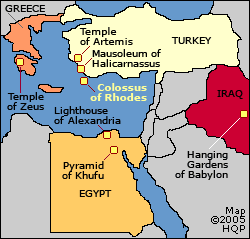
Seven Wonders map for
the Lighthouse of Alexandria


sponsored ad 

Explore my
candid country, region
and other travel guides

Click links for tips & insights


©2010 HQP / Hillman Quality Publications