

|

Helpful
vocabulary for your
Antarctica cruise
You will hear and read these terms during
your Antarctica cruise. Knowing their meanings will give you a head start in your
Antarctica learning adventure.

Icebergs and
their descendants
Iceberg
- A large floating body of ice broken off a glacier (a process called calving).
Bergy
bit - An iceberg is downgraded to a bergy bit when - by melting, splitting or
tumbling - it no longer rises at least 5 meters (16 feet) about water.
Growler
- A bergy bit is downgraded to a "growler" when it no longer rises at
least a meter (3 feet)
above the waterline. Ship captains fear them because they are numerous and are hard to spot.
Growlers have sunk many a vessel over the centuries. They derive their name from the
ominous sound they make when rubbing against a hull.

Other ice formations
Anchor
ice (also called ground ice) - An ice mass that is attached to the seabed or
other fixed underwater object. It's immobile and can be a navigational hazard,
especially when it is sizable and lies completely below water level.
Fast
ice - A floating ice pane fastened to the shore or an iceberg.
Ice
field - A huge, flat sheet of ice floating on the sea. It's called an ice
floe if smaller than 10 kilometers (6 miles) or so in length.
Pack ice
- Floating ice units that have been "packed together" into a single entity by
wind and currents.
Pancake ice
- Thin, small, disc-shaped, tightly grouped floating ice layers. They became
circular by the erosive force of repeatedly bumping into each other.
Rotten ice
- Ice that has become fragile, easily breakable because of its age.
Tabular
iceberg - A massive tabletop iceberg. Some measure over 50 kilometers (30
miles) or more in length. You see them in abundance when you sail through the Antarctica Sound, which
is aptly nicknamed "Iceberg Alley".

Other widely used terms
Austral summer
- This defines the southern hemisphere summer (Austral means "southern"). It
occurs when winter is taking place in the northern hemisphere.
Convergence
- It's where the warmer
and saltier Atlantic, Pacific and Indian Oceans collide with the colder and
less-dense Southern Ocean that surrounds
Antarctica. The convergence's line is an irregular circle that completely rings
the Antarctica continent - and is, on average, about 1,000 kilometers (600 miles)
from it.
Guano
- The excrement of penguins (and of bats and some seabirds).
Katabatic wind
- A strong, cold wind flowing downhill (due to gravitational action) on the
slopes of glaciers, ice fields and the polar cap.
Nunatak
- A partially buried peak or ridge. It protrudes dramatically like an island
from a glacier or snow field.
Pelagic
wildlife
- Those that live mainly in open sea, such as the Wandering Albatross.
Red penguin
- That's us, in our
bright red parkas.

There are several
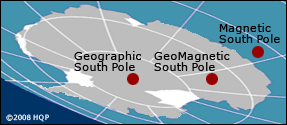
southern poles

Geographic
South Pole - This is what we normally think of when we hear the word "south
pole". By definition, it's the southern point of the axis of our planet's
rotation. Its latitude is exactly 90-degrees south.
Ceremonial
South Pole - This is a barber-striped pole encircled with national flags. It
is set into the ice at the Geographical South Pole (see above). It's a photo-op
symbol, not a scientific indicator. Because the polar ice cap at the Amundsen-Scott
South Pole Station drifts about 10 meters (33 feet) a year, the Ceremonial
South Pole is accurate only when the staff repositions the marker, which seldom
occurs.
Magnetic
South Pole - It's where you will end up if you follow the needle of your
compass until it points skyward. This pole changes its position regularly. It is
now submerged in the ocean, about 2,700 kilometers (1,700 miles) from the
Geographic South Pole, in the general direction of Australia.
Geomagnetic
South Pole - It resides approximately midway between the Geographic and Magnetic
South Poles - and like the latter, it wanders.
Click these buttons
for more tips & insights
Pages specific to the
Minerva cruise ship


Antarctica cruises
in general


Clickable Antarctica
wonder map

My "What it's Like"
cruise ship sections
to
view


My general
cruise ship section

Click the button below for Regent's website for Minerva itineraries with maps, a list of
cruise-specialist travel agents near you, plus other useful trip-planning
information.

|